
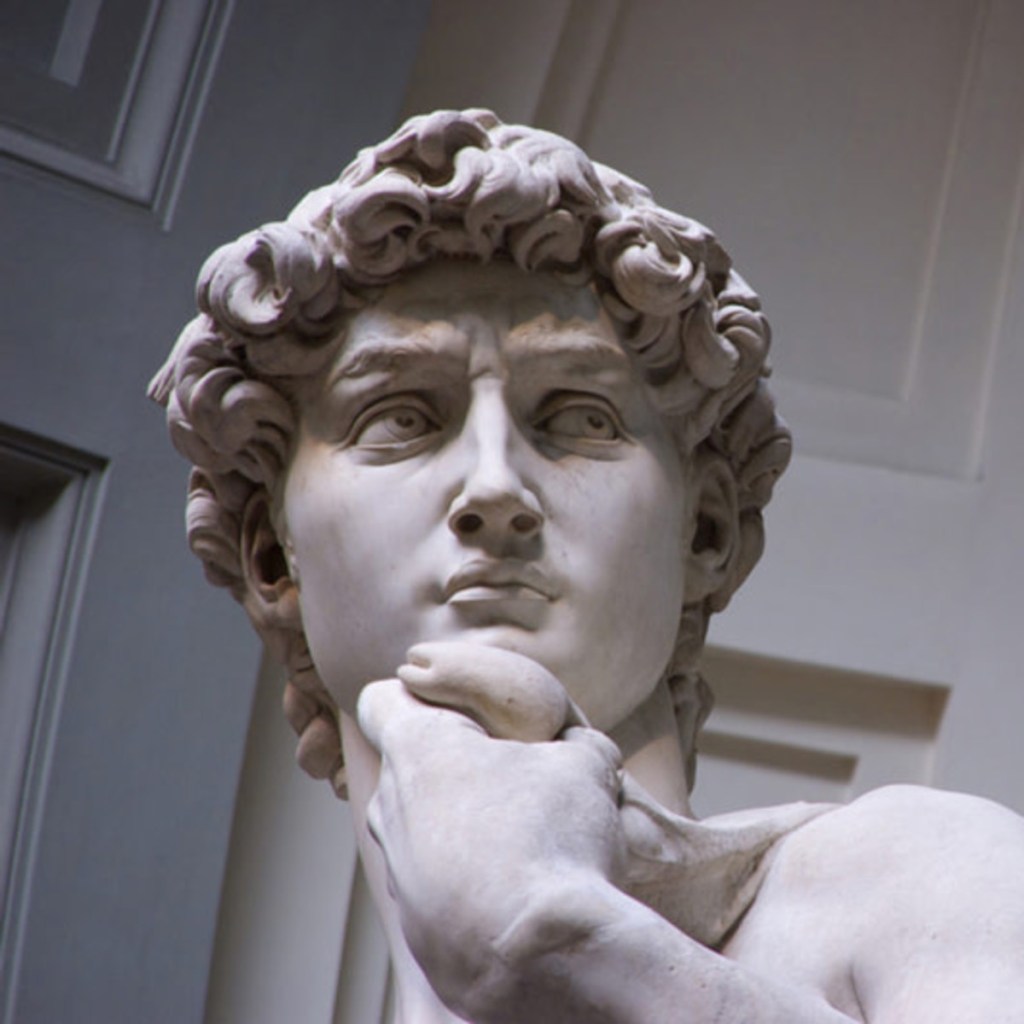
Many pieces of art get their fame from the stories associated with them. Others acquire fame because, even after centuries of observation, there is something within them that continues to intrigue us.
Michelangelo’s David is an example of such a work.
The colossal marble sculpture, created between 1501 and 1504, has established itself as one of the most recognizable works of Western art. The statue is more than five metres high and currently resides in the Galleria dell’Accademia in Florence.
However, David has always been more than just a sculpture.
Commissioned for Florence Cathedral, the sculpture eventually became a symbol of Florence, stood in the city’s public square for centuries, and was later moved to a museum for its protection. Its meaning changed throughout these different stages of its history.
This might be one of the reasons why David still captivates us.
The Marble Michelangelo Inherited
David’s story predates Michelangelo’s involvement with the stone.
The marble block was originally selected for a project connected to Florence Cathedral. Agostino di Duccio, the sculptor, began working on the large block in 1464. Antonio Rossellino later became involved, but that attempt was also abandoned.
The marble remained unused for many years before Michelangelo was commissioned to work on it in 1501.
This is an intriguing part of the story. David was not carved from an entirely untouched piece of stone chosen specifically for Michelangelo. The marble block already had a complicated history before he began working on it.
But Michelangelo recognized its potential.
One might think that this is another story about how genius triumphs over rejection. However, a more interesting lesson is that great works of art can have complex histories that begin long before the artist with whom we associate them.
The marble had a history.
Michelangelo added his own to it.
David Before the Fight
Michelangelo decided to depict an unusual moment from the biblical story of David and Goliath.
There is neither the decapitated head of the giant nor a scene of celebration after the victory.
Instead, we see David before the fight.
His body is motionless; however, there is nothing peaceful about it.
His head is slightly turned. His gaze is focused. His muscles are tense. The large hands and feet contribute to the impression that he is ready for action.
The sculpture captures an event that is about to happen.
This differs greatly from earlier Florentine images of David. Donatello and Verrocchio, for example, depicted the victorious hero. In contrast, Michelangelo chose to concentrate on the anticipation of the fight.
It completely changes the emotional experience of the work.
We are not looking at a hero celebrating his achievement.
We are looking at someone waiting to discover what happens next.
A Body Under Tension
One of the first things a viewer notices about David is the body.
Michelangelo understood human anatomy remarkably well, but he did not create the sculpture simply to demonstrate how muscular David could be. The way the body is posed conveys a sense of focus and restrained power.
David is posed in contrapposto, meaning that his weight rests primarily on one leg, causing the rest of the body to respond to that shift.
This is important because the statue is enormous, yet it does not feel static.
The body seems as if it could move at any time.
The hands are particularly notable. The right hand hangs beside the body while the left hand grips the sling over his shoulder, drawing attention to the preparation taking place within the figure.
The body and the face are both prepared for action.
The strength is clear, but Michelangelo does not show that strength through what David is doing.
He holds his power back.
It is possible that this is one of the reasons why the statue is so memorable. It asks viewers to see the hero of the battle before the fight actually takes place.
From Cathedral Project to Symbol of Florence
David was not originally intended to stand where it now stands.
It was commissioned for Florence Cathedral and was intended to be placed on one of the building’s exterior buttresses. But after Michelangelo completed the sculpture, a new question arose.
What could be done with such an extraordinary sculpture?
The answer was found in 1504, when Florentine officials and artists decided to place the sculpture at the entrance of the Palazzo Vecchio, the civic centre of Florence.
This decision gave the sculpture a new interpretation.
David became associated with the strength and independence of Florence because there were obvious parallels in the biblical story: a seemingly vulnerable figure confronting an opponent who was much stronger.
Placed at the heart of Florence’s civic life, the story could also be understood in relation to the city itself.
Now it was not just a piece of art to be admired.
The sculpture became part of the daily life of the people of Florence.
The importance of this context should not be overlooked.
Today, when looking at David in a museum, one can easily interpret it primarily as a masterpiece of Renaissance sculpture. But for centuries, its physical presence was also part of the public life of Florence.
David in the Public Square
David stood outside the Palazzo Vecchio for more than three centuries.
One can only imagine encountering the sculpture in such an open place rather than inside the controlled environment of a museum.
David was not hidden from the eyes of the citizens. He existed in a public environment where people walked around, conducted their business, assembled, debated and celebrated.
The surrounding environment was therefore an important part of the sculpture’s meaning. This is something that can also be seen in other monumental sculptures that have become closely connected with the identity of the cities where they stand.
However, the same environment that helped make the sculpture publicly accessible also left the marble vulnerable to damage.
By the nineteenth century, concerns about the sculpture’s condition had grown, and in 1873 it was moved from the Piazza della Signoria to the Galleria dell’Accademia.
The distance covered by David was only about 1.2 kilometres, but moving a marble sculpture weighing several tonnes was not a simple process.
A specially designed transportation system was created for the move, and it took ten days for the sculpture to reach its new home.
From the Piazza to the Accademia
The change from one space to another altered the context in which David was viewed.
Where David had once been part of the city of Florence and its activities, he became the centre of an architectural space created specifically for him.
The Tribuna at the Accademia was designed to house the sculpture, and David eventually became the focal point of another kind of viewing experience: the museum visit.
This is quite fascinating.
David has not changed in any way. Only the context in which we view him has changed.
Where a Florentine might have seen David in the sixteenth century within the context of civic life, a visitor today may see him after travelling thousands of kilometres and entering a room constructed around the sculpture.
The work of art remains the same.
The experience of seeing it changes.
Why Is Michelangelo’s David Still So Famous?
One might be tempted to give the simple response that David is beautiful.
Beauty, however, is not enough to account for its longevity.
Several different meanings have come together to make it a classic work.
The same question can be asked of other famous masterpieces, such as Leonardo da Vinci’s Mona Lisa, whose fame has also grown far beyond the circumstances in which it was originally created.
It is a great example of Renaissance sculpture.
It is an extraordinary demonstration of Michelangelo’s understanding of the human body.
It is a depiction of a figure from the Bible.
It became a symbol of Florence itself.
It is also an example of how an artwork’s meaning can change with the circumstances surrounding it.
Then there is the act of looking at it.
Photographs can show us the details and proportions of David. Books can reveal its history. Even a digital reproduction can provide access to details that would be difficult to see otherwise.
But a digital copy is still not the original.
The original has scale.
The original has presence.
The original demands that you walk around it.
It is a sculpture with things to see from different perspectives, rather than something that a photograph has already decided for you.
That could very well be one of the reasons why works of art continue to draw visitors, even today, when almost everything can be photographed and uploaded to the internet.
Looking at a reproduction tells us something.
Looking at the original gives us an experience.
Why David Still Speaks to Us
Perhaps the most interesting thing about David is that it does not give us only one way to understand it.
We can see courage in it.
We can see vulnerability.
We can see physical perfection, but also tension and uncertainty.
We can see a biblical story, a Renaissance masterpiece and a symbol of Florence.
And we can simply see a human figure standing still.
That last point may be more important than it first appears.
David has been standing for centuries.
The people who commissioned him are gone. The political circumstances that gave him a particular civic meaning have changed. The square where he once stood is no longer his home.
Yet the figure continues to confront each generation of viewers.
Perhaps that is what enduring art does.
It does not remain meaningful because its meaning never changes. It remains meaningful because it gives different generations something to think about.
Conclusion: The Moment Before Action
Michelangelo’s David is famous, but fame alone does not explain its survival.
Its power comes from the unusual moment Michelangelo chose to preserve: the instant before action, when strength, uncertainty, concentration and courage exist together.
The sculpture does not show us what happens next.
It makes us wait.
Five centuries later, that still feels remarkably human.
Perhaps that is why David continues to speak to us. Not because it tells us exactly what courage means, but because it captures the moment when courage has not yet become action—and asks us to imagine what comes next.
Image Source:
- Galleria dell’Accademia (official)
- Wikimedia Commons (public domain)
https://shorturl.fm/P5IEu
https://shorturl.fm/oAbof
https://shorturl.fm/LlEKc
https://shorturl.fm/YjIVw
https://shorturl.fm/WuHqT
https://shorturl.fm/KJGSu
https://shorturl.fm/48voV
https://shorturl.fm/SmuX7
https://shorturl.fm/wUTdt
https://shorturl.fm/8OHvc
https://shorturl.fm/iK8s0