The Benin Bronzes stand as some of the finest works of African art ever created. But they also stand out as some of the most controversial works in the history of collecting.
For more than one hundred years, many of the objects that make up the Benin Bronzes have been kept far away from where they originated. They were removed during a British military assault on Benin City in 1897, which involved the looting of a large number of objects.
But there is much more to the history of the Benin Bronzes than simply an account of colonial violence and restitution.
They are also a story of artists, royal power, memory, technology and visual language.
A close study of the Benin Bronzes reveals an artistic tradition that developed at the royal court of the Kingdom of Benin in what is now southern Nigeria. The plaques, heads, figures, ivory pieces and other objects were not simply decoration. They were used to commemorate royalty and ancestors, convey status, participate in rituals, and represent important people and events.
And their history stretches far beyond 1897—and continues to the present day.
What Are the Benin Bronzes?
“Benin Bronzes” is a convenient label; however, it can be misleading.
It is frequently applied to a large collection of artworks created in the Kingdom of Benin. Many of these pieces are made of cast brass or other copper alloys rather than, strictly speaking, bronze. Other materials, including ivory, are also represented.
According to the Smithsonian, “Benin bronzes” is a catch-all term for works made from cast-copper alloy and ivory. The British Museum notes that many of its Benin plaques are made of brass.
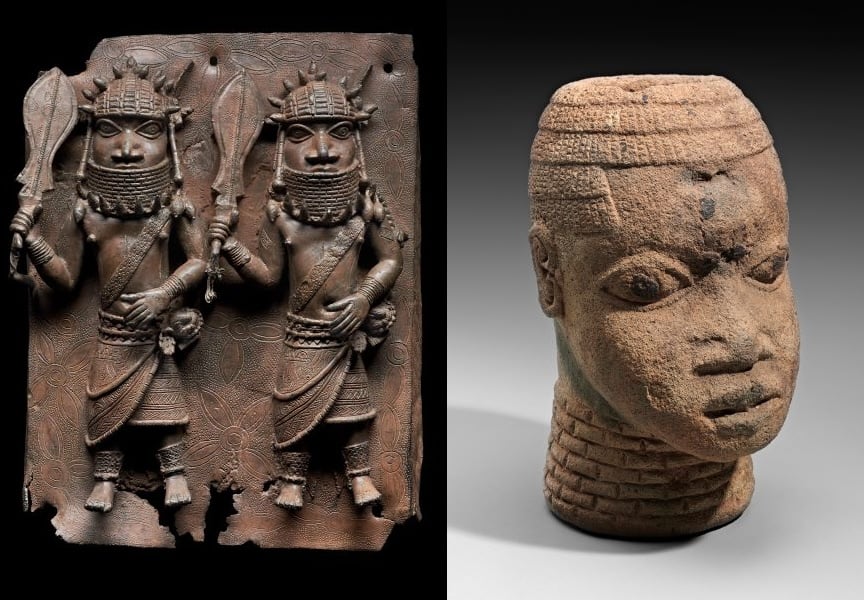
Among the most famous objects are rectangular brass plaques that decorated the royal palace, commemorative heads of kings and queen mothers, figures of courtiers and warriors, ritual and ceremonial objects, and carved ivory tusks.
These artworks were produced at different times and for various purposes, so they cannot be regarded as a single artistic category.
What unites many of them is their connection to the royal court and institutions of the Kingdom of Benin.
A Royal Art Tradition
Benin had a highly organised court culture in which art was an important part of royal life.
The Oba, or king of Benin, was a central figure in the political and religious life of the kingdom. Court artists created objects for use in the palace and in rituals, while specialised guilds were responsible for different forms of artistic production.
The Metropolitan Museum of Art identifies the Ìgùn Ẹ́rọ̀nwwọ̀n, or brass-casting guild, with the production of many of the cast-brass artworks for which Benin is known. The guild operated under royal patronage and developed highly specialised casting and metalworking skills.
This was not an isolated activity but part of a larger system of court life.
The palace was the setting for many of these works. Hundreds of brass plaques were once attached to wooden pillars in the royal palace, forming part of an elaborate visual environment. The plaques depicted rulers, courtiers, warriors, historical events and aspects of court life.
It created a rich artistic tradition in which craftsmanship and politics came together.
What Did the Artists Make?
The well-known plaques are among the best-known examples.
They show the Oba, courtiers, warriors, officials and foreigners, among others. In many cases, figures are arranged hierarchically through variations in scale, position, clothing and regalia.
It is for this reason that the plaques are such intriguing works of art.
The modern viewer may naturally ask whether the artist attempted to produce a realistic portrait of an individual. However, Benin court art did not necessarily use the same principles as a modern portrait.
The size, position, clothing and regalia of a figure could communicate rank and significance.
Therefore, the artwork did not necessarily attempt to represent the physical appearance of an individual in the way that a contemporary photograph does.
Rather, appearance became a language of power.
Coral beads, elaborate clothing, jewellery, weapons and other objects could communicate the rank and significance of the person being represented.
The Importance of the Royal Head
Among the most striking works created by Benin artists are cast-brass heads of the Oba.
Such sculptures were linked to ancestral altars in the royal palace. According to the Metropolitan Museum of Art, when a new Oba succeeded his father, he was expected to honour his father with a cast-brass commemorative head placed on an altar, helping maintain the relationship between the living ruler and his predecessors.
The sculpture possessed a meaning beyond the representation of an individual.
Within the symbolic meanings associated with royal heads, the head was connected with control over the body and success in a person’s life. In the context of the royal altar, the image of the deceased king was also linked to the authority and prosperity of the state.
This explains one aspect of Benin art.
A work of art could be aesthetically pleasing, technically brilliant and politically relevant at the same time.
Its role was not limited to being admired in a museum.
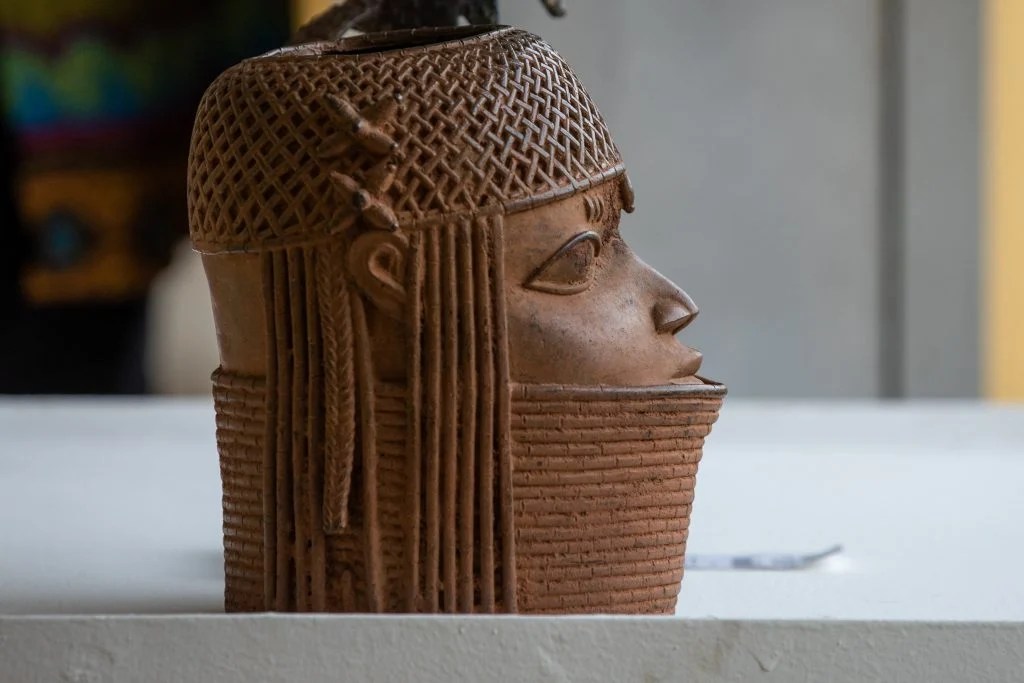
The Head of a the king Oba of Benin is displayed at the signing ceremony and handover of the 119 Benin bronzes returned from the Netherlands to Nigeria at the National museum Onikan in Lagos on June 21, 2025. Photo: Toyin Adedokun / AFP via Getty Images
Art, Memory and the Royal Ancestors
A link between art and memory is a recurring feature of Benin court art.
Commemorative heads played a role in maintaining the connection between the court of the present and its deceased rulers. There were also objects connected to royal altars, ceremonies, significant figures and historical events.
Together, these objects can be understood as part of a visual culture of memory, connecting rulers, ancestors, rituals and events from history.
Digital Benin has gathered information on thousands of historical objects, along with oral histories, archives, provenance studies and Edo language resources. The project explains that these objects were used for purposes including royal representation, the depiction of historical events, communication, worship and ritual.
One reason it is important to view the Benin Bronzes not only as “treasures” is that they were part of a living culture.
The Artists and the Lost-Wax Process
The technical prowess of Benin’s metal artisans is another significant part of the story.
Many of the renowned sculptures were crafted using the lost-wax technique. In essence, a model is fashioned from wax, encased in a mould and then replaced with molten metal when the wax is melted away.
This technique enables an artist to create intricate forms and surfaces, although it demands considerable expertise.
A brief and simplistic explanation of the development of this technique in West Africa does not tell the whole story. According to royal traditions of Benin, the development of brass casting was connected to knowledge transferred from Ife, including the story of the Ife master Iguegha during the reign of Oba Esigie. At the same time, the wider history of lost-wax casting in West Africa is more complicated and cannot simply be traced to a single place of origin.
What is important for understanding the development of Benin art is that the technique became part of a highly developed local tradition.
Benin artists employed metalworking technology to create a distinctive visual language for the royal court.
Metal became a medium for history, power and ceremony.
Benin and the Wider World
However, the artists in Benin were not isolated from the wider world.
The kingdom maintained contacts with surrounding societies and with Europeans who came to the shores of West Africa.
There are several depictions of Portuguese people in Benin works of art. For example, one brass plaque in the Metropolitan Museum of Art depicts Portuguese traders alongside brass manillas, connecting the foreigners with an important form of wealth in Benin.
These depictions are important because they show that Benin artists were aware of a changing world and incorporated elements of it into their works.
It is also important to note that the depiction of Europeans in Benin art does not imply simple imitation of European culture.
They were depicted within the visual system of Benin.
The 1897 British Punitive Expedition Against Benin
The history of the Benin Bronzes changed significantly in 1897.
British forces attacked and captured Benin City, including the royal palace, following escalating tensions between British authorities and the Kingdom of Benin. The expedition resulted in widespread looting.
A considerable number of artefacts were carried away from Benin and subsequently dispersed.
The British Museum documents that objects made of brass, ivory, coral and wood were looted from the royal palace, storerooms and compounds during the British expedition. The Smithsonian likewise states that the Benin objects it returned to Nigeria had been stolen during the 1897 British raid on Benin City.
This event is extremely important for understanding why the Benin Bronzes are different from many other collections of historical objects now held in museums abroad.
Their transfer was linked to a specific act of military violence and colonial expansion.
These objects did not leave Benin through ordinary trading channels.
From Palace Objects to Museum Collections
Following the 1897 raid, Benin objects entered European and American collections through various means.
Some were sold, some passed through the hands of dealers, and others were eventually donated to museums. The British Museum notes that many objects brought to Britain after the expedition were sold through private auctions, donated to museums or retained by members of the expedition.
As time progressed, the objects gained prominence in the international art world.
Their exceptional technical quality challenged long-held European assumptions about the artistic abilities of Africans.
However, there was an uncomfortable paradox.
The very objects that museums began to celebrate as masterpieces had been looted from Benin in connection with a military expedition.
Their great artistic value could not obscure the circumstances through which many of them came into European collections.
Quite the contrary, it drew attention to the issue.
Why the Term “Benin Bronzes” Can Hide the Story
The phrase is so common that it can make the objects appear as though they belong to a single type of thing.
Yet every object has its own story.
The commemorative head serves a different purpose from the palace plaque. The ivory tusk has a different history from the cast-brass figure. An object created hundreds of years ago does not necessarily have the same meaning as one created at a later time.
That is why it is important to study the provenance of these artefacts.
Knowing where an object was created is only the beginning. We also need to know:
Who made it?
What was it made for?
Where was it originally kept?
Who owned it?
When did it leave Benin?
Who acquired it afterwards?
How did it eventually reach a museum?
Those questions turn a museum label into a history.
Restitution and the Return of the Objects
The question of what should happen to Benin objects held abroad has been debated for decades by Nigerian officials, the Benin Royal Palace, museums, researchers and cultural institutions.
Yet in recent years, the debate has produced tangible results, including returns and transfers of ownership.
On 11 October 2022, the Smithsonian Institution transferred ownership of 29 Benin objects to Nigeria’s National Commission for Museums and Monuments. Nine of the works remained in Washington under a loan agreement after the transfer of ownership, allowing them to continue to be displayed at the National Museum of African Art.
In June 2025, the Netherlands returned 119 Benin objects to Nigeria. The Dutch government had approved the return of 113 objects from the Dutch State Collection, while six additional objects were returned by the Municipality of Rotterdam. The official handover took place on 21 June 2025 at the National Museum in Lagos.
Then, on 8 February 2026, the University of Cambridge announced that it had transferred legal ownership of 116 Benin artefacts in the collections of its Museum of Archaeology and Anthropology to Nigeria’s National Commission for Museums and Monuments. The objects had been taken by British forces during the sacking of Benin City in February 1897. Physical transfer of the majority of the artefacts is to be arranged, while 17 pieces are to remain on loan and on display at the museum for an initial period of three years.
This is important because restitution is now more than a theoretical question.
The legal ownership of objects has changed, and in some cases their physical location has changed as well.
What Does Restitution Actually Restore?
It might be easy to define restitution simply as the return of objects.
But it can mean much more than that.
Returning an object can reconnect it with its place of origin, its people and its cultural context. It can also allow researchers, artists, students and members of the public in Nigeria to encounter works that had previously been accessible mainly through foreign museums or reproductions.
However, restitution cannot mean wiping out history.
Those objects may have been kept in foreign museums for decades or even centuries. During that time, they acquired exhibition histories, scholarly interpretations and collecting histories.
All of this is now part of their history.
The task, therefore, is not just to decide where an object should physically remain.
It is also to reconsider:
Who gets to interpret it?
Who gets to access it?
Whose historical context is placed at the centre of the story?
A Global Collection with a Local History
Digital Benin offers a striking picture of the scale of the dispersal.
Its platform currently brings together information on 5,304 objects from 139 institutions in 21 countries, alongside oral histories, archival documents, provenance research and Edo terminology.
This makes it possible to study the dispersed objects as part of a connected cultural history.
And this may be one of the most important developments in the study of the Benin artefacts.
Even without the physical return of every object, information can be brought together.
An artefact located in London can be studied alongside an artefact in Berlin, Washington, Cambridge or Benin City.
The digital record can help reconstruct relationships that physical dispersal made difficult to see.
Why the Benin Bronzes Still Matter as Art
Restitution arguments can at times draw attention away from the objects themselves.
It would be a mistake to let that happen.
The Benin Bronzes are significant in their own right because they are outstanding examples of art.
This is evident in the craftsmanship of the pieces and the symbolism they contain. The Benin Bronzes demonstrate artistic skill through their surface designs, composition and execution. They express hierarchy and identity through the postures, costumes and scale of the figures depicted.
They also reflect a society that was able to organise specialised artistic production around its royal court.
Looking closely at them therefore changes the question.
The issue is not simply:
Who owns the Benin Bronzes?
It is also:
What do these works tell us about the people who made them?
And perhaps an even more interesting question:
What happens to the meaning of an artwork when it is separated from the cultural system for which it was created?
The Story Is Still Unfolding
The story of the Benin Bronzes does not have a tidy end.
Some artefacts have been returned to Nigeria, while others have changed legal ownership. Many remain in museums and collections across the globe. Further research continues to reveal provenance histories and connections between objects.
The Benin Bronzes have therefore become much more than symbols of a past era of colonisation.
They are also part of an ongoing discussion about museums, ownership, remembrance, cultural heritage and the role of institutions that hold artefacts taken in the context of colonial violence.
But beneath all of this lies the art itself.
The brass plaques.
The royal heads.
The figures of warriors and courtiers.
The ivory works.
Objects created by talented artists for a specific court, a specific society and a specific world.
Studying these objects means studying the history of Benin as it was seen through the eyes and hands of its artists.
Pingback: The World’s Most Famous Sculpture: Why Michelangelo’s David Still Speaks to Us – Esefoke Timeless Art
Pingback: The Fascinating Evolution of Bolivian Art